Why a Clear Route Makes a Room Easier to Read
A clear route through a room helps you record daily journeys, test furniture positions, and choose a layout that avoids awkward turns without stripping its character.
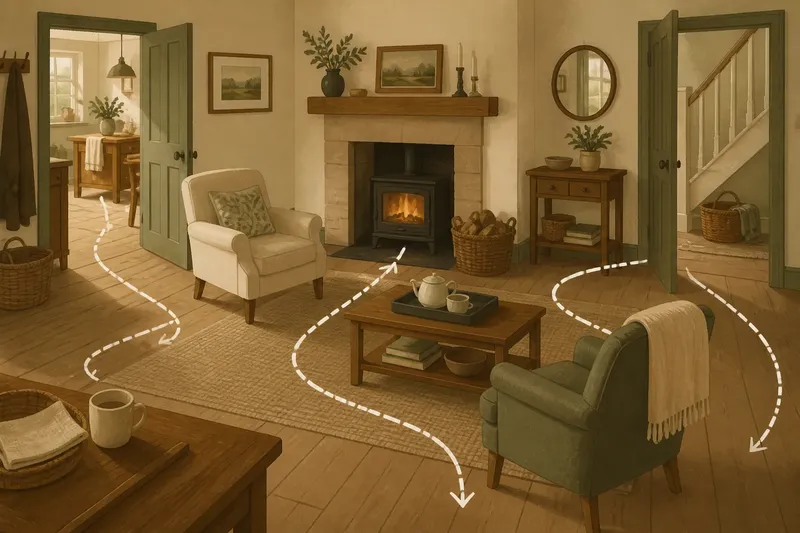
A clear route through a room starts with the journeys people actually make. Before shifting a settle or dragging a table across the boards, note where people walk, pause, and turn while carrying ordinary things.
In a country room, the route may run from the kitchen door to the hearth, from the stairs to a chair, or around a table set for daily use. The aim is not to leave every passage broad and empty. It is to find out which movements happen often and where furniture makes them awkward.
Notice the usual paths
Watch the room during ordinary activity rather than judging it while empty. Someone carrying a mug, a basket of kindling, or folded laundry will take a different line from someone crossing to the window. Both movements count, though they may not deserve equal priority.
Look for repeated signs: a rug corner that gets nudged, a chair that is regularly pulled aside, or a narrow gap people turn sideways to pass through. These are records of use, not evidence that anyone has failed to appreciate the furniture.
Notice where people pause as well as where they walk. A stop beside the hearth to put down logs, or near a sideboard to set down a tray, can make a route feel congested even when the floor looks open. The landing point is part of the path.
For a few days, jot down common journeys and the objects carried. A scrap of paper is enough. Keep the record practical, not forensic.
Separate routes by purpose
Some paths connect the room to its busiest doors: an entrance to the kitchen, or a doorway to the stairs. Others serve a particular activity, such as reaching a reading chair or carrying dishes to the table. Give the main connection the clearest line; smaller routes can bend around it if the detour remains comfortable.
Pay attention to door swings and drawers. A door occupies space briefly but predictably; an open drawer can block a route just when someone needs to pass. Judge the room in use, not only with everything shut and tucked away.
Notice sightlines, too. From the entrance, a chair that blocks the view of the hearth can make the room seem harder to read, even if there is a usable route around it. A clear route is physical and visual: the eye should be able to pick out a sensible way in.
Give the most frequent journey the simplest line, then see what remains for occasional tasks.
Test a proposed layout
Imagine a sitting room with a kitchen door at one end, a hearth on the long wall, and a low table between two chairs. Someone carrying a tea tray repeatedly turns sideways between the table and the nearer chair. The useful observation is that the tray route and the chair’s working space overlap.
Before moving anything, stand at each doorway and trace the usual journeys with your eyes. Then walk them at an ordinary pace, carrying a light object if that reflects the task. A book or empty basket will do. Notice where you shorten a step, change direction, or reach to steady yourself on a chair back.
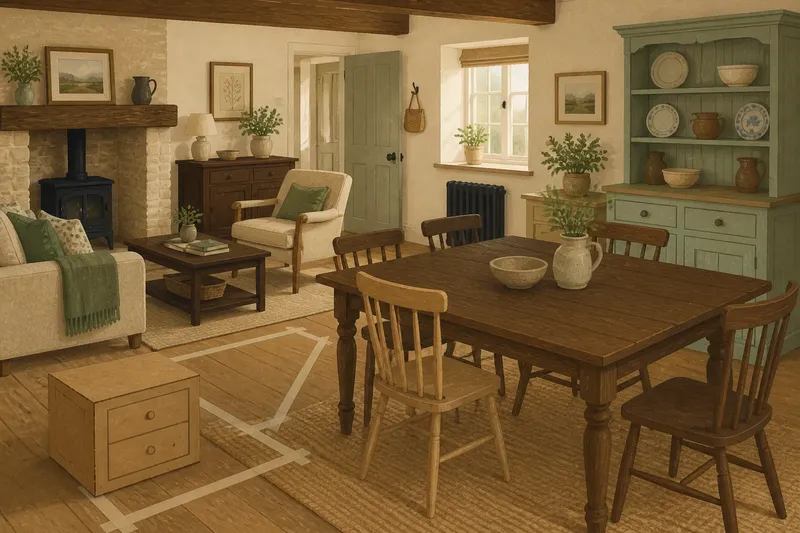
Where the floor finish allows, use removable painter’s tape to mark the proposed edge of a furniture footprint. Test the space needed to pull out the chair and use the table, not just the space needed to pass by.
In this imagined room, moving the nearer chair a little toward the hearth might open the tray route while keeping both chairs oriented toward the fire. The observable result to look for is a less cramped turn and a table that remains reachable. If the route improves but the chair becomes awkward to use, the change has traded one problem for another.
For a reusable check, record each observation and choose the next action from what happens:
- If the same route is used often, mark its start, destination, and carried object; then preserve its simplest comfortable line. If it is occasional, allow a gentle detour rather than giving it priority over the main connection.
- If someone turns sideways at the same furniture gap, note which chair or table edge causes it; then tape a proposed new furniture edge and walk the route again. If the turn remains, test another position or remove a smaller obstruction.
- If a chair is pulled aside repeatedly, note where it moves and what activity it serves; then test a position that leaves room to use it. If that blocks the main route, keep the chair where it is and adjust another piece.
- If people pause to put down a tray, logs, or laundry, mark the stopping point; then keep that landing area clear. If clearing it disrupts seating or storage, test a nearby surface that does not cross the route.
- If an open door or drawer interrupts a journey, note which one and when it is open; then test the layout with it fully open. If the obstruction remains, change the furniture position or keep that route clear by another arrangement.
- If the route looks unclear from the doorway, note the object that blocks the view toward the destination; then test a lower or shifted position for that piece. If the sightline improves but access worsens, restore the position and clear a different visual obstruction.
In the imagined sitting room, the notes might read: kitchen door to table, tea tray, frequent; sideways turn at the nearer chair; chair pulled aside when people pass. The actual test is to tape a position slightly nearer the hearth, walk the tray route, and sit down and stand up from the chair. If the tray turn opens and the chair remains usable, keep the change; if not, restore it and test the table edge instead. The answer is not “move the chair” in every room. It is whichever arrangement resolves the recorded obstruction without creating a worse one.
Questions about clear routes?
Should every route be straight?
No. A gentle curve around a table or hearth can follow the way people already move. The useful test is whether the route feels obvious and comfortable, not whether it resembles a corridor.
Should furniture sit against the walls?
Not necessarily. Pulling a chair away from a wall can make it easier to reach, while moving a small table nearer the wall can open a crossing. Let observed movement decide which arrangement earns the floor space.
How can a narrow room stay usable?
Prioritize one dependable route between the most-used doors or activity areas. Keep small pieces from interrupting that line, and check that seating remains reachable without shifting another chair.
What if two routes cross?
Consider whether one journey happens often enough to deserve a direct line and whether the other can pass behind seating or around the table. If both are frequent, adjust the furniture footprints to reduce the overlap rather than asking people to take turns at a pinch point.
Make one change
Move a single piece, then repeat the ordinary journeys. Changing several chairs and tables together makes it harder to tell which adjustment helped. A small shift may be enough when the obstruction is a chair corner rather than the whole seating plan.
Check the room during different kinds of use. A path that works for one person carrying a cup may not work when several people gather around the table. The arrangement need not serve every occasion equally, but the trade-off should be deliberate.
For a clear route through a room, follow the paths people actually take, including where they stop and what they carry. Keep the notes beside the furniture plan: the next time a chair moves, you will know which route the change is meant to improve.